In today’s IT Services Firm market, valuation isn’t just a metric for when you’re ready to sell. It’s a real-time indicator of operational health, scalability, and competitive positioning. Private equity groups, strategic buyers, and sophisticated investors use a consistent set of filters to determine whether your IT Services Firm earns a single-digit multiple or commands a premium double-digit multiple. The best part? These drivers are largely in your control— and intentional focus on them can transform your business long before an exit. The 7 Drivers of Premium IT Services Firm Valuation 1. Revenue Scale Scale signals market relevance and operational maturity. Larger IT Services Firms with higher top-line revenue attract a broader pool of buyers and often secure better financing terms in a transaction. Crossing key revenue thresholds of $20M in annual revenue can significantly lift your multiple. Investors see scale as a hedge against volatility, as larger firms typically have more resources, brand recognition, and bargaining power. 2. Growth Sustained growth — particularly organic growth — demonstrates market demand and operational strength. Buyers look closely at your three-year CAGR (Compound Annual Growth Rate) to ensure it’s both consistent and achievable without excessive risk. Growth above 15% annually often marks the tipping point for premium multiples. A balanced mix of new client acquisition, upselling, and cross-selling is viewed more favorably than growth driven solely by aggressive discounting or one-off projects. 3. Recurring Revenue Predictable recurring revenue streams are the bedrock of high valuations. Investors want to see a strong percentage — often above 70% — of revenue coming from ongoing service contracts rather than one-time projects. Recurring revenue provides stability, makes cash flow more predictable, and reduces the perceived risk for buyers. Multi-year agreements with built-in price escalators are particularly attractive because they compound value over time. 4. EBITDA Margins EBITDA margins reflect how efficiently your IT Services Firm converts revenue into profit. Margins above 20% send a clear signal that you have strong cost controls, efficient service delivery, and pricing discipline. High margins also give buyers confidence that the business can weather market fluctuations while still delivering returns. Margins below 10% suggest potential operational inefficiencies or underpricing, both of which will be red flags during due diligence. 5. Top 10 Client Concentration A healthy client mix is critical to de-risking your business. If your top 10clients make up too high a percentage of revenue — especially if a single client accounts for over 15% — buyers will factor that risk into your valuation. Diversification spreads risk and protects cash flow if one client reduces spend or leaves. Strong client concentration management also demonstrates resilience and a focus on sustainable revenue streams rather than over-reliance on a few accounts. 6. Operationalized KPIs Investors want evidence that you track, analyze, and act on operational metrics consistently. KPIs like ticket resolution times, SLA compliance rates, and net promoter scores should be monitored and tied to business decisions. An IT Services Firm with operationalized KPIs can prove performance trends instead of relying on anecdotal evidence. This level of operational rigor gives buyers confidence in both the current stability and future scalability of the business. 7. Automation Automation is no longer optional — it’s a core profitability driver. The more you can automate repetitive tasks like patch management, onboarding, billing, and reporting, the more efficiently your team can operate. Automation reduces labor costs, minimizes errors, and frees skilled employees to focus on higher-value work. Buyers see well-implemented automation as a lever for immediate margin improvement and a sign that the business is future-ready. The Value Gap Between Single and Double Digit Multiples A single-digit multiple IT Services Firm often shows: < $20M revenue < 10% growth < 50% recurring revenue EBITDA margins < 10% High client concentration Minimal KPI tracking and little automation A double-digit multiple IT Services Firm typically has: $50M revenue 15% growth 70% recurring revenue EBITDA margins > 20% Retention > 90% Deep KPI visibility and significant process automation

Five Core Insights Every IT Services Leader Should Know
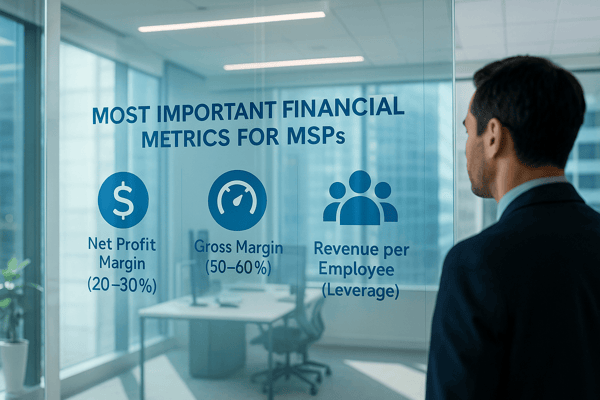
Driving Value For Your IT Services Firm: Five Core Insights Every IT Services Leader Should Know The Most Valuable Financial Metrics for IT Services Firms When it comes to running a healthy, growing IT services business, not all dollars are created equal. A mid-year review is a perfect time to understand which metrics matter most and how to adjust course while there is still time to hit year-end goals. ConnectWise’s 2025 financial review identifies five areas every CFO should watch: 1. Revenue growth and mix. Revenue is the foundation of profitability, but not all revenue is good revenue. Low-value sources include clients outside your ideal technology stack or unprofitable one-off projects. Focus on retaining satisfied clients, cross-selling your full suite of core offerings, implementing value-based price adjustments, and pursuing high-growth customers. 2. Product gross margin. Product margin should exceed 27% for best-in-class performance. Improve this by charging for value, holding regular QBRs to set expectations, consolidating vendors, and bundling services rather than quoting individual line items. 3. Services gross margin. Top IT Services Firms achieve service margins around 48%. Raise margins by eliminating discounting, standardizing your technology stack, focusing on a single customer profile, and documenting processes to drive efficiency. 4. SG&A leverage. Selling, general, and administrative costs erode gross margin. Best-in-class providers spend about$0.58 of every dollar of gross margin on SG&A, leaving $0.42 for profit and reinvestment. Grow gross margin faster than overhead, align marketing spend with ROI, and consider a zero-based budgeting review to reset spending. 5. Current ratio. Ensure current assets comfortably cover current liabilities; strong liquidity allows you to invest in growth without jeopardizing operations. These metrics go beyond simple revenue and provide a comprehensive picture of financial health. A fractional CFO can help set targets, monitor progress, and ensure pricing, operations, and investments align with strategic financial goals.